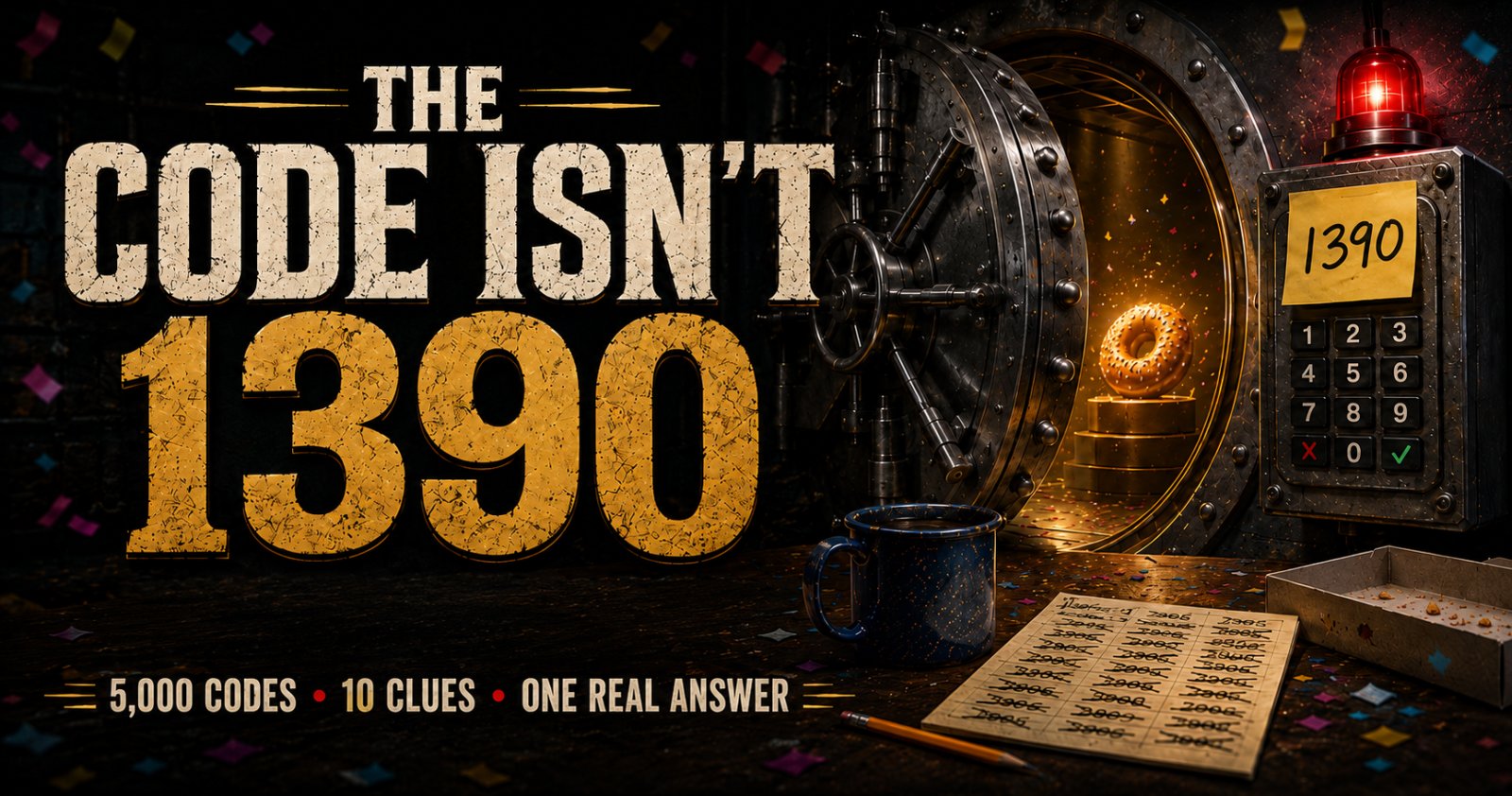
Okay, friend, picture this: you are standing in the break room at Bramble & Bixby Oddities Warehouse when the vault suddenly slams shut around the priceless Golden Donut of Destiny.
Is this a normal workplace problem? Absolutely not. Is it somehow still less stressful than a meeting that could have been an email? Honestly, yes.
The confetti cannons are charging, a yellow sticky note on the keypad says 1390, and the vault has already made one thing very clear: that code is a fake. So now you have to find the real four-digit combination before the break room becomes a glittery crime scene that facilities will be cleaning until retirement.
That is where The Code Isn't 1390 begins—a printable elimination puzzle with 5,000 possible codes, 10 clues, and one real answer.
First, every code is a suspect
In a traditional elimination mystery, you might begin with a list of suspicious people. One has a questionable alibi. Another owns far too many shovels. Someone else keeps saying, "Why would I steal the diamond?" even though nobody mentioned a diamond.
In this puzzle, the suspects are numbers.
You begin with every possible four-digit code from 0001 through 5000. That means all 5,000 possibilities are sitting there on the code-list pages, looking innocent and minding their own numerical business.
Yes, all 5,000.
I heard your pencil sigh. Stay with me.
You are not expected to enter thousands of guesses into the keypad. That would be less "clever deduction puzzle" and more "how quickly can I make these confetti cannons my personal problem?" Instead, you use the clues to eliminate entire groups of impossible codes until only the real one can remain.
So, how does the elimination actually work?
The puzzle gives you 10 clues, and every clue reveals something that must be true about the real vault code. A clue does not simply hand you the answer. It gives you a piece of evidence—and your job is to use that evidence against every code still under investigation.
- Read one clue. Take your time and make sure you understand what it tells you about the real code.
- Turn that clue into a rule. Ask yourself, "What would make a code fail this test?"
- Scan the remaining possibilities. Look for codes that contradict what you just learned.
- Cross off the impossible codes. If a code breaks the rule, it is officially out of the investigation. Goodbye. Thank you for playing. Please collect your imaginary consolation prize on the way out.
- Move to the next clue. Apply the new evidence only to the codes that survived the earlier clues.
That last part matters: you are not starting over with all 5,000 codes every single time. Each clue makes the next round smaller. The giant wall of numbers begins to thin out, and suddenly the impossible-looking puzzle starts looking very possible.
Thousands become hundreds. Hundreds become a much shorter list. That list becomes a tiny group of highly suspicious survivors. Then the full trail of evidence—including the fact that the code definitely is not 1390—leaves you with the real combination.
What kind of clues will you be working with?
Nice try, detective. I am not sneaking any actual clues into this post. Mr. Bixby would revoke my vault privileges, and I do not own enough velvet capes to appeal the decision.
What I can tell you is that the puzzle asks you to examine the four digits from several different angles. You will pay attention to digit patterns, work with numerical relationships, use real arithmetic, and encounter a playful word-based twist along the way.
Nothing requires advanced mathematics or mysterious formulas last seen on a chalkboard in a movie about geniuses. You will be using familiar operations, careful reading, and logical thinking. A calculator is perfectly acceptable if you want one. Mr. Bixby is guarding a donut, not grading your homework.
Some clues will let you sweep away large groups of codes in one deeply satisfying pass. Others will make you slow down, compare the survivors, and check your work. Every elimination is supported by evidence, so you never have to rely on a random guess or a lucky hunch.
The best part is watching the list collapse
There is something wonderfully satisfying about a puzzle that lets you see your progress.
At the beginning, the code list looks enormous. It may even have a little attitude. But then you finish the first clue and start drawing lines through the codes that no longer qualify. You apply the next clue, and more possibilities disappear. Soon the pages that once looked intimidating are covered in proof that you are, in fact, smarter than a dramatic warehouse owner with a suspicious cape collection.
The goal is not to recognize the correct code immediately. The goal is to make every wrong code prove that it does not belong.
That is the heart of an elimination puzzle. You are not waiting for inspiration to strike. You are building the answer one logical decision at a time.
You can solve it your way
If you love the full detective experience, print the ink-friendly clue and code-list pages, grab a pencil, and start crossing things off by hand. A pencil is helpful because occasionally your eyes and your enthusiasm may not agree about which row you are on. It happens to the best of us.
If paper is not your thing, you can open the PDF on a tablet or computer and use digital markup tools instead. You still get the satisfying cross-offs, just without discovering pencil shavings in places pencil shavings have no business being.
You can also choose your preferred investigation style:
- Solve solo for a quiet, brainy challenge with no one questioning your very serious detective face.
- Work with a partner and compare how each of you interprets the evidence.
- Make it a group challenge by dividing the work, passing the code sheets around, and politely debating which possibilities need to go.
The expected solving time is about 60–90 minutes, so this is not a tiny puzzle you finish while waiting for the microwave. It is a proper sit-down challenge—the kind where you settle in, make notes, cross off possibilities, and become emotionally invested in the fate of a fictional pastry.
And if one clue makes your brain leave the building?
You will have access to an optional online hint for every clue. The hints are designed to give you a nudge without snatching away the fun of figuring it out yourself.
When you believe you have found the real vault code, you can use the online answer checker to test it. The answer is never printed where an accidental glance can spoil the mystery. You decide when you are ready to lock in your final code and face the consequences.
No pressure. It is only the Golden Donut of Destiny, the dignity of the entire break room, and a lifetime supply of confetti cleanup hanging in the balance.
Will this puzzle be your kind of challenge?
You will probably have a wonderful time with The Code Isn't 1390 if you enjoy:
- Logic and deduction puzzles
- Crossing suspects—or numbers—off a list
- Escape-room-style code cracking
- Math that feels like part of a mystery instead of an assignment
- Visible progress and satisfying "aha!" moments
- Family-friendly stories with delightfully ridiculous stakes
And if you are the kind of solver who draws one neat line through an eliminated code, I admire your restraint. If you are more of a "SCRIBBLE IT OUT, YOU ARE DEAD TO ME" solver, I understand you completely.
Ready to investigate?
The Code Isn't 1390 is coming soon. When it arrives, you will receive the complete themed puzzle, print-friendly solving pages, optional hints, and online answer verification.
Until then, prepare your pencil, warm up your detective brain, and remember the most important fact in this entire investigation:
The code is not 1390. Nice try, panic-guesser.
Follow Simply Creative Puzzles on Patreon so you do not miss the release. Then tell me: are you tackling all 5,000 codes alone, or are you recruiting a team to help save the donut?
0 Comments
Be the first to comment.