Most murder mystery puzzles are polite enough to give you a manageable suspect list.
Maybe six people. Perhaps eight. A suspicious gardener. A wealthy widow. Someone named Reginald who definitely owns too many waistcoats.
The Killer Is in the Ledger does not believe in being polite.
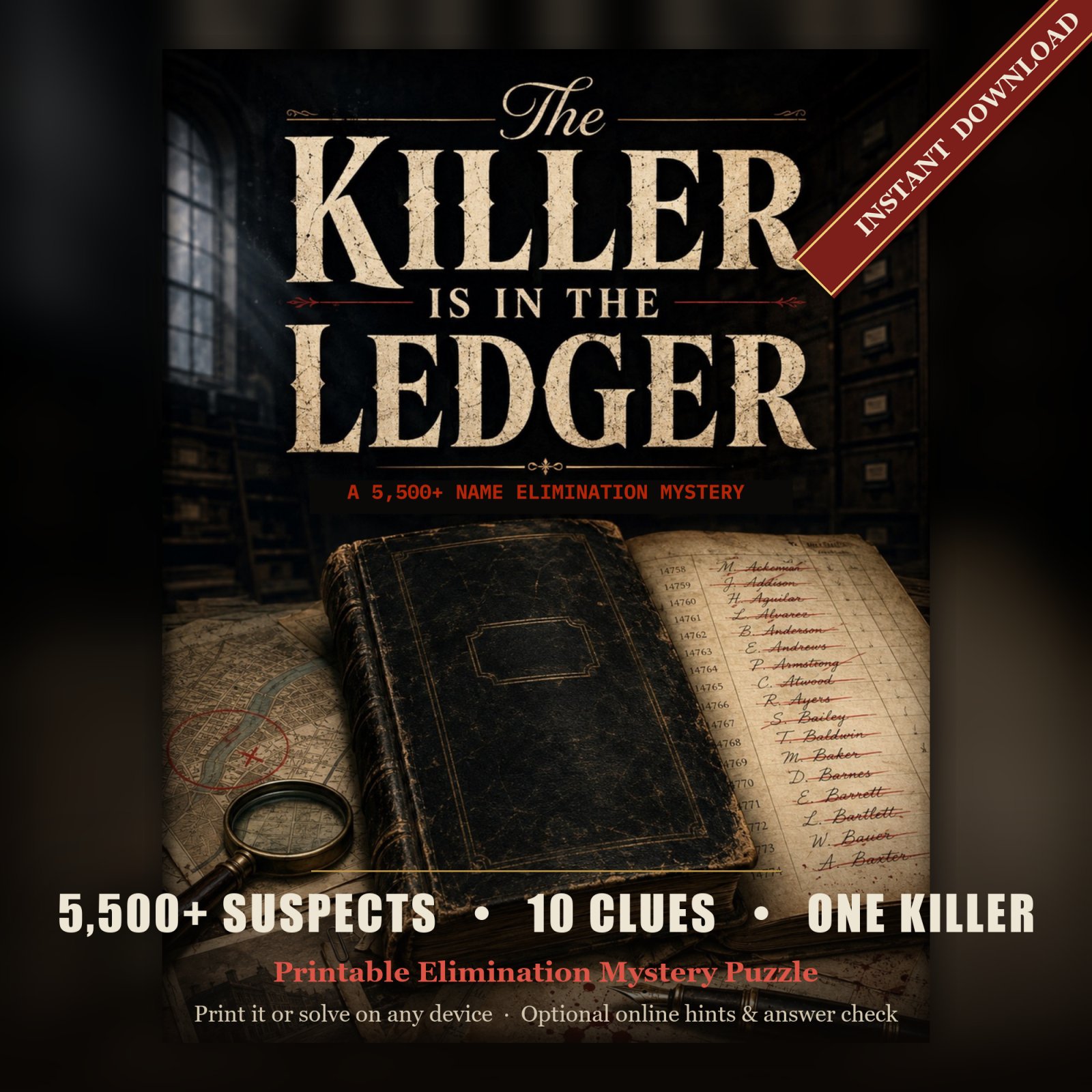
It gives you more than 5,500 suspects.
Yes. Five thousand five hundred names.
Somewhere inside that ridiculous sea of perfectly innocent-looking letters is a killer. Your job is to find the one guilty name without questioning witnesses, analyzing fingerprints, checking alibis, or dramatically removing your sunglasses while announcing that the evidence was there all along.
Instead, you get a ledger, 10 clues, a pencil, and the unsettling realization that the alphabet has apparently joined a criminal investigation.
The Crime Is Only the Beginning
At 11:57 p.m., the lights fail inside the Archive Hall of the Grand Meridian Museum. When they come back on, billionaire collector Elias Vorn is dead beside the glass case holding the city's oldest criminal registry, The Night Ledger.
The final line has been torn away.
The cameras caught no useful face. No weapon was recovered. Fingerprints are no help.
But carved into the wooden reading table is a trail of strange marks: letters, scratches, and patterns that appear to be nonsense.
Until the detective realizes something rather inconvenient.
The marks aren't describing the crime. They're describing the killer's name.
And suddenly those thousands of names in the ledger look a lot less decorative.
You Don't Guess the Killer. You Eliminate Everyone Else.
This is where The Killer Is in the Ledger takes a sharp turn away from a traditional whodunit.
There are no character cards telling you that Margaret was in the conservatory at 8:14 p.m. There is no chart involving Professor Plum, a candlestick, and an unfortunate misunderstanding near the billiard room.
There aren't even traditional suspects.
Every name in the ledger is a suspect until the clues clear it.
You work through 10 clues in order. Each clue gives you another rule for eliminating names. You may be looking at alphabetical position, name length, vowels, consonant patterns, letter relationships, or even a little letter-value math.
Apply the clue correctly. Cross off the names that don't belong. Move to the next clue.
Thousands become hundreds.
Hundreds become fewer.
The pages begin looking significantly less crowded.
And at some point you will become personally offended by a four-letter name for surviving longer than expected.
The Elimination Is the Puzzle
That's what makes this mystery feel different.
You aren't waiting for one enormous AHA! moment that magically solves the entire case. The satisfaction comes from watching an impossible suspect pool slowly collapse under the weight of careful deduction.
Each clue changes what remains. Each crossed-out name gets you closer. Each page becomes evidence of your increasingly aggressive relationship with a pencil.
And because the clues must be followed in order, there's a wonderful sense that you're tracking the killer step by step.
No luck. No random guessing. No secretly deciding that a name sounds guilty because, frankly, Bernard has been acting suspicious since page twelve.
Just logic.
Part Murder Mystery, Part Logic Puzzle, Part 'Why Are There So Many Names?'
The puzzle is designed as a substantial sit-down challenge rather than a five-minute printable. Plan on roughly 45–90 minutes, depending on your solving style, your pattern-spotting skills, and whether you stop occasionally to glare dramatically at the ledger.
You can solve it alone for a proper armchair-detective evening, work through it with a partner, or split ledger pages among family or friends and compare survivors as you move through the clues.
It's also family-friendly and non-graphic. The mystery involves a murder, but the focus is entirely on deduction rather than gore. Because the clues involve reading, alphabetizing, patterns, and a little math, it works especially well for older kids, teens, and adults who enjoy brain teasers.
Print It, Mark It Up, Destroy Thousands of Alibis
The digital download includes the full themed puzzle plus a printer-friendly black-and-white version. If you love the satisfying scratch of pencil on paper, print the clue sheet and ledger pages and start crossing.
Prefer fewer pages roaming around your house looking like mysterious government documents? You can also open the PDF on a tablet or computer and annotate it digitally.
And if one of the clues makes you consider filing a formal complaint against the alphabet, there are optional online hints for every clue. Once you've narrowed the ledger down to your final suspect, you can verify your answer online without having the solution spoiled ahead of time.
So, Is This Like Other Mystery Puzzles?
Not really.
It's less Which of these six suspicious dinner guests did it? and more Here are 5,500 names. Good luck, detective.
It combines the atmosphere of a locked-archive murder mystery with the deeply satisfying mechanics of an elimination puzzle. The story gives you the case. The clues give you the rules. The ledger gives you approximately five thousand opportunities to cross something out with purpose.
And when only one name remains?
That's your killer.
No confession required.
If you're ready for a printable mystery that does things a little differently, get The Killer Is in the Ledger on Etsy and open the case.
5,500+ suspects. 10 clues. One surviving name.
Try not to trust anybody.
Especially the vowels.
0 Comments
Be the first to comment.